φ-FEM
A finite element method on domains defined by level-sets
Finite elements on simple meshes, for domains of complex shape.
φ-FEM is an immersed boundary finite element method. The mesh does not fit the boundary of the domain. The geometry enters the scheme through a level-set function φ.
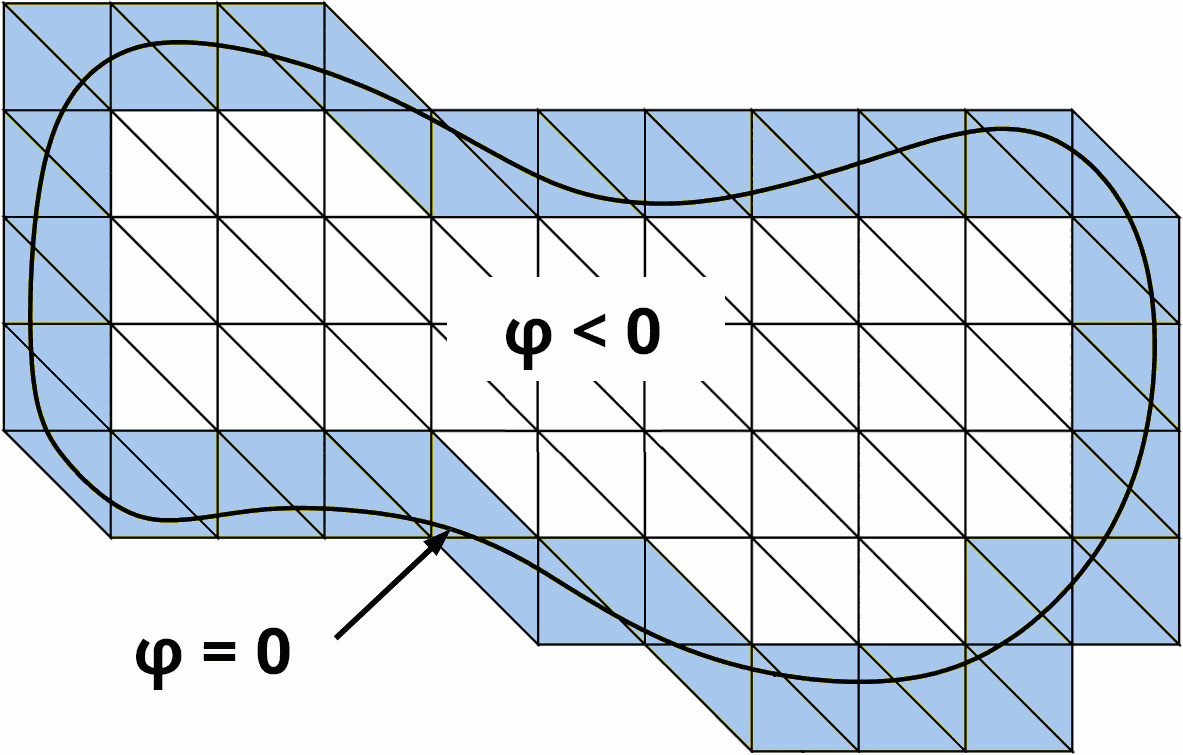
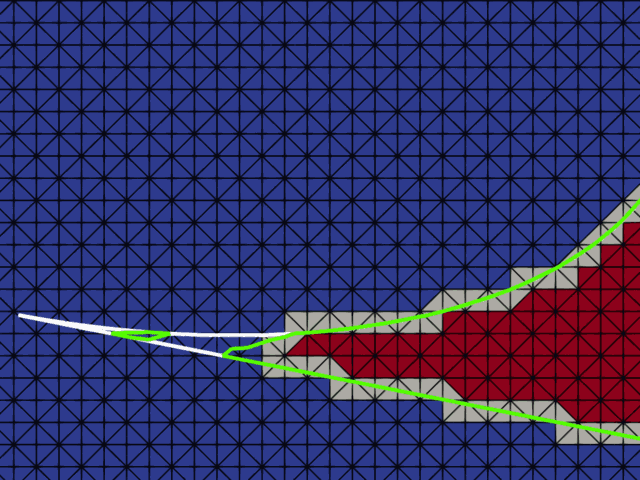
No fitted mesh
The method uses a simple background mesh. No mesh of the physical domain is needed. A level-set function can describe complicated or evolving domains.
Standard tools
φ-FEM uses standard finite element spaces. Unlike CutFEM or XFEM, it needs no integration on cut cells or on the actual boundary. It can be implemented in general finite element libraries.
Optimal accuracy
For the Poisson problem, the convergence is proved to be optimal with finite elements of any degree. The condition number is of the same order as for a standard finite element method on a fitted mesh.
The idea
For Dirichlet conditions, we look for the solution as a product \(u_h = \varphi_h w_h\). Here \(w_h\) is a standard finite element function and \(\varphi_h\) is an interpolation of the level-set function. This product vanishes on the boundary. A ghost penalty term stabilises the scheme.
The scheme and the main results are on the page The method.
Get started
The phiFEM package provides tools to implement φ-FEM schemes in FEniCSx. Inside the dolfinx Docker container:
pip install phifemThe installation, the demos and the code of each article are on the page Software.
Reference
M. Duprez and A. Lozinski, φ-FEM: a finite element method on domains defined by level-sets, SIAM J. Numer. Anal. 58 (2020), no. 2, pp. 1008-1028, doi, preprint (hal).
All the articles are on the page Publications.
Support
The development of φ-FEM is supported by the ANR JCJC project φ-FEM (ANR-22-CE46-0003, 2022-2027), coordinated by Michel Duprez (Inria, MIMESIS team, Strasbourg). The members of the project are listed on the project page.